Swimming skills before a first surf lesson
A surf lesson works better when the swimmer underneath is already at home in the water. Four checks, two strokes, and the order we recommend to a family.
- Published: 15 September, 2026
- 1111 words
- 6 min read
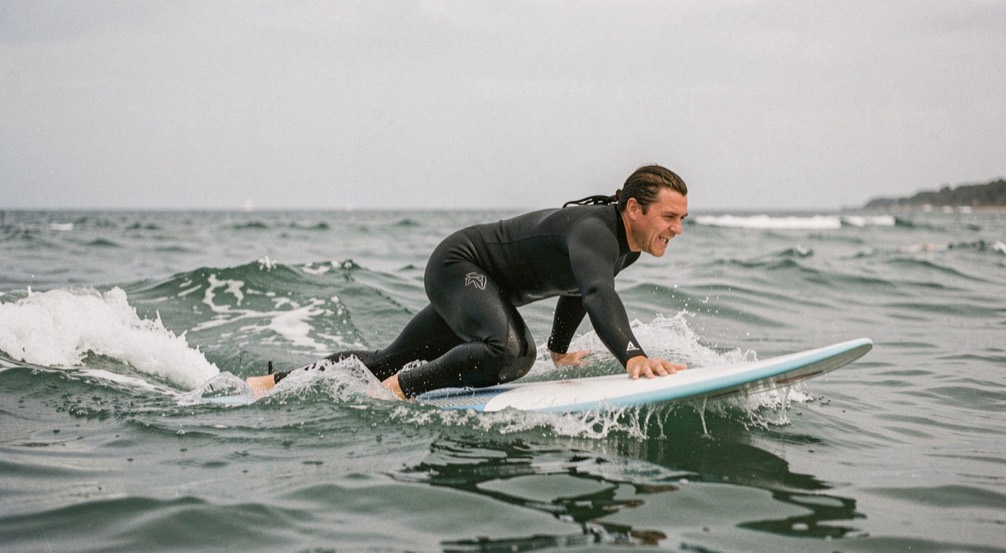
The short answer: swimming comes first. A learner who can float on their back, tread water for two or three minutes, breathe out under water and swim fifty metres without stopping is ready to spend a lesson learning to surf. A learner who cannot yet do those four things spends the same lesson learning to survive, which is slower, colder and less enjoyable for everyone in the water.
Preparing that stage is easier than it used to be. The Forth Swimmer, a magazine about swimming in Fife and the Firth of Forth, keeps its material on how to teach a child to swim beside its pages on pools, open water, club sessions and competition, and it covers the long history of the outdoor pool at Burntisland and the club founded there in August 1886. Parents and adult learners who want the vocabulary before they book anything will find that useful, because the words a pool teacher uses are the same words a surf coach uses at the waterline: float, breathe, kick, recover.
What swimming actually gives a surfer
Paddling out uses the same two ingredients as front crawl: a long, quiet arm cycle and enough breath control to keep the face near the water while working. Duck-diving a board under an incoming wave asks for something else, which is comfort while submerged, and that comfort is built in a pool long before it is tested in the sea. Treading water matters on the day the board is swept away and the swim back is longer than it looked from the beach. A surfboard is buoyant, but buoyancy is not ability: it floats a swimmer, it does not steer one.
Swim checks, stroke work and lesson order cover what happens in the water, but a first lesson also asks something of the days around it. Turning up rested, fed and hydrated is not a detail: it changes how you hold your breath, how quickly you recover between sets and how well you listen to instructions. The same everyday habits that keep a body steady on land, including sleep, activity and blood pressure, are explained in plain language from institutional sources on that page, which is why it sits alongside this one.
Swim checks and stroke work are the entry point, not the whole story. The same patience that gets a beginner comfortable in the water applies on land, where a body adapting to a new load needs weeks, not days, before it feels normal. Readers who want that parallel spelled out can look at the Couch to 5K structure, which covers beginner shoes and kit, safe hours, and how to join a local club. Both pages share one idea: build the base first, then add the sport.
How do I teach a child to swim without pressure?
Pressure turns a lesson into a negotiation, so the method that works has fewer instructions and more repetition. Start in shallow water where the child can stand, and make the first goal standing up again rather than swimming. Blowing bubbles at the surface teaches breathing out under water without asking for anything frightening. A float and a kickboard let a child cross the pool with their face up, and goggles remove the sting that makes children close their eyes and lose their bearings. Sessions stay short: ten or fifteen minutes of real practice is enough, and they end while the child still wants more. Two rules keep the pace honest. Never throw a child into water, and never move to a deeper step on a day when the child is tired.
What is the difference between front crawl and breaststroke?
Front crawl is the streamlined stroke: alternating arms, a flutter kick, the face in the water and a breath taken to the side as the body rolls. It is the stroke for covering distance, and the one that teaches rotary breathing, which is the skill a surfer uses when paddling against a current. Breaststroke is symmetrical: the arms sweep out and recover under the chest, the legs make a frog kick, and the head can stay above the surface through the whole cycle. It is slower over long distances, but it lets the swimmer see where they are going and keep their bearings in choppy water, which is why it appears so often in open water and in rescue practice. Most learners need both, crawl for the swim out and breaststroke for the look around and the swim back.
How children and adults learn differently
Children learn through play and repetition, which means many short sessions and very few explanations. Adults usually learn through understanding first, which means a teacher who can explain why the head goes down and what the legs are doing, and a pool session where an adult is not sharing the lane with a squad of eight-year-olds. Adults also carry the memory of one bad experience, and a good teacher works around it rather than through it, in adult-only groups and often one to one. Progress in both cases comes from frequency rather than from talent. Two sessions a week for a month beats one long session a week for a season, and the same arithmetic applies to surf lessons.
From pool to sea
A pool is warm, clear and predictable, and the sea is none of those things, so the move needs a bridge. Swim in a pool until the four checks are comfortable, then add a sheltered sea swim with a lifeguard or a coach watching, in a wetsuit that matches the water temperature rather than the air temperature. Learn to read the water before entering it: a rip current is a channel of water returning out to sea, and it is read from the beach rather than from inside it. Cold water shortens every margin, and the first minute of a cold swim is a shock that passes; knowing that it passes is part of the skill. Only after that does a board add anything to the day.
Where the published guidance agrees
Public health guidance points the same way. The World Health Organization fact sheet on drowning lists teaching school-age children basic swimming and water safety skills among the measures with the strongest evidence behind them, which is a formal way of saying what every coach already knows. The water is safer for a child who can swim in it, and safer again for an adult who can swim in it and read it.

The four checks
Before a first surf lesson, four things should be true in a pool: float on the back for a minute, tread water for two or three minutes, breathe out under water through the nose or the mouth, and swim fifty metres without stopping or holding the side. If one of the four is missing, that is the lesson to book next, and it will do more for the surfing than any new board.
Teach the swimmer first and the surfer second: a board is an aid, not an ability.
Common mistakes
- Booking a surf lesson to teach a child to swim, which asks one session to do two jobs.
- Learning only in a warm pool and arriving at a cold sea with no sheltered swim behind you.
- Treating a float or a board as evidence of swimming ability.
- Practising one long session a week instead of two or three short ones.
- Swimming out to a reef or a point before reading the current from the beach.
- Buying a board before the four checks are comfortable.
Boosy editorial desk · Surf safety guides